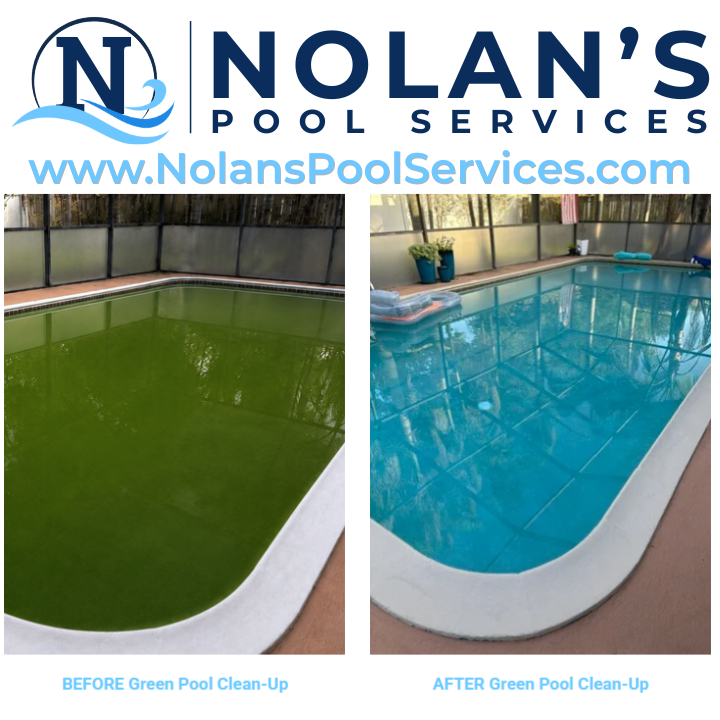

If you live in Lakeland, Winter Haven, or anywhere else in Polk County, you know the drill. It’s 4:00 PM in July, the sky turns a bruised shade of purple, and within minutes, a wall of water descends on your backyard. These Florida summer storms are legendary, but for pool owners, they often bring a frustrating surprise the next morning: a pool that has gone from sparkling blue to a murky, swampy green.
At Nolan’s Pool Services, we see this every single day during the rainy season. It’s tempting to panic and run to the nearest big-box store to buy every "algae killer" on the shelf. But before you spend hundreds of dollars on "magic" chemicals, we want to give you the honest truth about green pool algae treatment.
In this guide, we’ll break down exactly why those storms turn your water green and the step-by-step process we use to restore pools back to crystal clear: without the pushy upsells or unnecessary hidden fees.
Why Florida Storms are an "Algae Factory"
Florida’s climate is unique, and our storms do more than just add extra water to your pool. They create a perfect storm of biological and chemical factors that favor algae growth over your chlorine’s ability to stop it.
1. Massive Chlorine Dilution
A heavy Polk County downpour can easily drop three or four inches of rain in a single afternoon. That’s a significant amount of fresh water entering your pool. This rain effectively performs a partial water change, diluting your free chlorine, stabilizer (cyanuric acid), and alkalinity. When your chlorine levels drop to near zero, it takes less than 24 hours in the Florida heat for algae spores to multiply into a visible bloom.
2. The pH Rollercoaster
Florida rain is naturally acidic, often sitting around a pH of 5.0. Your pool water needs to stay between 7.2 and 7.6 for your chlorine to actually work. When acidic rainwater floods your pool, it drags the pH down. In an acidic environment, your chlorine becomes much less effective at killing algae. Even if your test kit shows you have some chlorine, it might be "lazy" chlorine that isn't doing its job because the pH is out of whack.
3. Organic Debris and Phosphates
The high winds of a summer storm blow in more than just rain. They carry dirt, leaves, grass clippings, and pollen from our lush Lakeland landscapes. This debris isn't just a mess to clean up; it’s food. As this organic matter decomposes, it releases nitrogen and phosphates: the primary nutrients that algae thrive on.
The Honest Truth: You Don’t Always Need a "System Flush
One of the reasons we started Nolan’s Pool Services 15 years ago was that we saw too many homeowners being taken advantage of after a storm. Many "big-box" pool companies will tell you that a green pool requires a "total drain and refill" or a $500 "emergency treatment package."
Here is the truth: Most of the time, a green pool can be fixed with proper pool chemical balancing and a heavy, targeted shock. You don't need "miracle" products with fancy names. You need the right amount of the right chemicals, at the right time. Our philosophy is simple: we only recommend what’s actually needed to get your water safe and clear. We treat every pool like it’s our own, and we hate wasting money as much as you do.
The 6-Step Green-to-Clean Recovery Plan
If you’re tackling the green monster yourself, follow this professional-grade protocol. This is the same logic we use when performing pool maintenance in Florida during the peak of summer.
Step 1: Clear the Debris Immediately
Don't wait. As soon as the lightning stops, get the leaves and branches out. Debris in the water consumes chlorine rapidly. The longer those leaves sit on the bottom, the more "food" you’re giving the algae.
Step 2: Test and Balance the pH
This is where most DIYers fail. They dump five bags of shock into a pool with a pH of 6.8. In that environment, about 70% of that shock is wasted. You must bring your pH into the 7.2–7.4 range first using soda ash. This "primes" the water so that when the chlorine hits, it hits hard.
Step 3: The "Heavy" Shock
For a green pool, a standard dose of shock won't cut it. You need a "breakpoint" dose: essentially 3 to 5 times the normal amount, depending on how dark the green is. We recommend using a high-quality calcium hypochlorite (cal-hypo) shock.
**Light Green/Cloudy:** 2-3 lbs per 10,000 gallons.
**Dark "Pea Soup" Green:** 5-6 lbs per 10,000 gallons.
*Pro tip: Always shock in the evening. The Florida sun is a chlorine-killer; shocking at night gives the chemicals 10–12 hours to work without UV interference.*
Step 4: Scrub the Walls
Algae creates a "biofilm": a slimy layer that protects it from chlorine. You have to physically break that layer. Use a heavy-duty pool brush to scrub the walls, steps, and especially behind the ladder. This exposes the "roots" of the algae to the shock you just added.
Step 5: Run the Filter 24/7
Your filter is your best friend during a cleanup. You need to run your pump continuously until the water is clear. If you have a sand or DE filter, you’ll likely need to backwash it daily during this process to remove the dead algae that’s being trapped. If you have a cartridge filter, be prepared to spray it down thoroughly every 24 hours.
Step 6: Algaecide and Clarifier (The Finishing Touches)
Once the water turns from green to a cloudy white/gray, it means the algae is dead. Now you can add a quality algaecide to prevent a secondary bloom and a clarifier to help the dead algae particles clump together so the filter can grab them.
Why Local Experience Matters in Polk County
There’s a big difference between a pool in Ohio and a pool in Winter Haven. In Polk County, we deal with extreme heat and high humidity that keeps water temperatures in the mid-to-upper 80s all summer long. Warm water is the ultimate breeding ground for bacteria and algae.
At Nolan's, we have 15 years of experience navigating the specific challenges of pool cleaning in Lakeland, FL. We know which neighborhoods have higher phosphate issues due to nearby citrus groves or heavy lawn fertilization and we adjust our chemical balancing accordingly.
Prevention: How to Stop the Green Before It Starts
While you can't stop the rain, you can prepare your pool to handle it.
- Keep your chlorine high: During the summer, we recommend keeping your free chlorine at the higher end of the scale (around 3.0 ppm). This gives you a "buffer" when the rain dilutes it.
- Check your baskets: Keep skimmer and pump baskets clear so that circulation stays strong.
- Pre-Storm Shock: If a major tropical system or a heavy week of rain is forecasted, adding a preemptive bag of shock can keep your sanitizer levels from bottoming out.
- Professional Maintenance: The most reliable way to avoid a green pool is consistent, weekly service. Our weekly pool cleaning ensures your chemistry is never more than seven days away from a professional adjustment.
Trust the Pros for a Crystal Clear Result
Cleaning a green pool is a lot of work. It involves heavy lifting, constant monitoring, and handling concentrated chemicals. If you’d rather spend your weekend enjoying your backyard instead of fighting an algae war, we’re here to help.
At Nolan’s Pool Services, we pride ourselves on being the most reliable, honest, and punctual pool care team in Polk County. Whether you need a one-time green-to-clean or a dependable partner for year-round maintenance, we promise fair pricing with no surprise charges: just professional care and crystal-clear results.
Ready to get your pool back?
Contact Nolan’s Pool Services today for a free quote on our green pool algae treatment or to schedule your regular pool cleaning in Lakeland, FL. Let us take the stress out of the storm so you can get back to swimming!