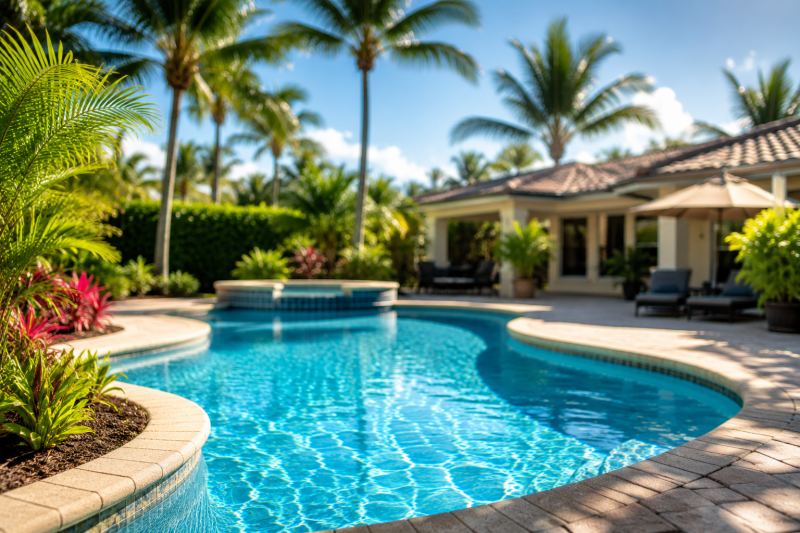

If you’re reading this, you either just bought a house in Polk County with a pool, or you’re tired of looking at a green swamp in your backyard and wondering where you went wrong.
I’ve been in the pool industry for 15 years right here in Central Florida. I’ve seen it all: from perfectly balanced paradise retreats to "DIY experiments" that ended up costing the homeowner thousands in resurfacing fees. My name is Nolan, and I don't believe in sugarcoating things.
Owning a pool in Florida in 2026 is a different ballgame than it was even five years ago. Between new safety laws, skyrocketing chemical costs, and the sheer intensity of our weather, you need more than a net and a prayer to keep your water clear. Here is the honest truth about pool maintenance in Florida.
The Florida Triple Threat: Sun, Heat, and Rain
In most states, a pool is a seasonal luxury. In Florida, it’s a year-round commitment. Our climate is essentially a laboratory designed to grow algae as fast as humanly possible.
- The Sun: Our UV rays don't just burn your skin; they burn through chlorine. You can have a perfectly balanced pool at 8:00 AM, and by 4:00 PM on a July afternoon, your sanitizer levels can be near zero.
- The Heat: Hot water is the perfect breeding ground for bacteria. When the water temperature hits the mid-80s or 90s, your chemical demand triples.
- The Rain: We get those heavy afternoon downpours that dump several inches of fresh water into your pool. That water isn't just "free fill": it’s acidic, it carries pollutants, and it dilutes your salt and stabilizer levels instantly.
Without precise pool chemical balancing, your pool can turn from blue to "shrek green" in less than 48 hours. This is why residential pool cleaning in our area isn't a hobby: it's a necessity.
The Legal Side: The 2026 Safety Act Update
If you are planning on selling your home or just moving into one, pay attention. The Florida Residential Swimming Pool Safety Act has been around for a while, but as of October 1, 2026, the rules have tightened up significantly for property transfers.
Regardless of when your pool was built, if you sell or transfer a home with a pool after this date, the pool must be equipped with at least one approved safety feature. This isn't just a "good idea": it’s the law. Approved features include:
- An approved safety barrier (fence) at least 4 feet high.
- Exit alarms on all doors and windows leading to the pool area.
- Self-closing, self-latching devices on doors with a release mechanism 54 inches above the floor.
- An ASTM-certified in-pool alarm.
I always tell my customers in Lakeland and Winter Haven: don't wait for a home inspection to fail before you look into pool safety. It’s about more than compliance; it’s about making sure the kids and pets in our community are safe.
The Real Cost of Ownership
I get asked all the time: "Nolan, what is this actually going to cost me?" Here’s the breakdown for a standard residential pool in 2026:
- Chemicals & Upkeep: If you’re doing it yourself, expect to spend $100–$150 a month on quality chemicals. If you hire a pro for pool cleaning in Lakeland, FL, you’re looking at roughly $140–$180 a month, which includes the labor and the chemicals.
- Electricity: Your pump is one of the biggest energy hogs in your house.
- The "Surprise" Fund: You should budget at least $1,000 a year for wear and tear. O-rings fail, salt cells scale up, and filters eventually need replacing.
If someone tells you a pool only costs $50 a month to run, they’re lying to you (or their pool is currently a mosquito breeding ground).
Equipment Truths: The Heart of Your Pool
In 2026, the era of the old-school, single-speed "jet engine" pump is over. Modern Florida pools require variable-speed pumps (VSPs).
Why? Because they are quiet, and they save you a fortune on your electric bill. A VSP can pay for itself in energy savings in less than two years. However, keep in mind that equipment lifespan in Florida is shorter than in other states. The salt air, the humidity, and the constant run times mean a pump that might last 12 years in Ohio might only last 7 or 8 here in Polk County.
When it comes to pool equipment, my advice is simple: buy quality parts and don't skip the routine maintenance. A $50 seal replacement today can save you from a $800 motor replacement next month.
DIY vs. Pro: Why Your Weekends Matter
Look, I’m a straight-shooter. You can maintain your own pool. People do it. But most homeowners I talk to in Winter Haven and Bartow eventually realize that their "relaxing" pool has become a part-time job.
A professional pool service in Winter Haven doesn't just skim leaves. We are watching the phosphate levels, checking the LSI (Langelier Saturation Index) to make sure your marcite isn't being eaten away by acidic water, and catching equipment leaks before they flood your yard.
When you hire a pro, you aren't just paying for chlorine; you’re buying back your Saturday mornings and the peace of mind that when you jump in, the water is actually sanitary.
The Bottom Line
Florida pool ownership is a massive responsibility, but when it’s done right, there’s nothing better. The secret isn't some "magic" chemical; it’s consistency.
If you want a pool service that gives you the honest truth, shows up when we say we will, and treats your backyard like our own, give us a shout. We serve Lakeland, Winter Haven, Auburndale, and all of Polk County. No pushy upsells, no hidden fees: just crystal-clear results.